Independent Redistricting Commissions: What They Change (and What They Don’t)
Independent commissions can reduce partisan gerrymandering, increase competition, and keep communities intact. They do not erase geography or polarization.
- 32 claims
- 30 match a source
- 0 need one
- 0 unreachable
- 2 corrected
30 of 32 claims match a source; 2 corrected
Claim by claim: what the check found
| Claim | Finding |
|---|---|
| States redraw legislative maps every ten years | Matches a source |
| In most states, the party in power draws the lines | Matches a source |
| Some states have independent or citizen commissions; others have politician or advisory commissions that can be overridden | Matches a source |
| Analyses of California's post-2011 Citizens Redistricting Commission maps find measurable changes in competitiveness and partisan outcomes | Matches a source |
| North Carolina's court-drawn map produced a 7D-7R result in 2022 | Matches a source |
| The 2023 legislative redraw could produce up to 11R-3D | Matches a source |
| The Brennan Center piece is dated Oct 27, 2023 | Matches a source |
| The Supreme Court held partisan gerrymandering claims non-justiciable in federal court (Rucho v. Common Cause, 2019) | Matches a source |
| The Pennsylvania Supreme Court struck down the 2011 congressional map in 2018 as a partisan gerrymander under the state constitution | Matches a source |
| The court forced a remedial map for 2018 | Matches a source |
| Ohio's process ignored judicial orders across repeated rounds of litigation (2021 to 2022) | Matches a source |
| Ohio voters were left with maps that courts had rejected | Matches a source |
| Federal lawsuits argued North Carolina's 2023 congressional and legislative maps illegally diluted Black voting power | Matches a source |
| Texas maps face Voting Rights Act and racial vote dilution claims | Matches a source |
| The Texas litigation concerns "2021 maps litigated into the 2026 cycle" | Corrected to match its source |
| Texas line-drawing weakens districts where Black and Latino voters have elected candidates of choice | Corrected to match its source |
| New York (2026): even with an independent redistricting commission, maps can be challenged and courts can order redraws on tight timelines | Matches a source |
| SCOTUSblog, Feb 2026, Democrats ask the Supreme Court not to disrupt the New York dispute | Matches a source |
| Democracy Docket, Feb 2026: New York appellate court allows the redraw to move forward | Matches a source |
| Most commissions explicitly prioritize communities of interest | Matches a source |
| North Carolina's 2023 map produced a 10R-4D result in 2024 | Matches a source |
| Under the 2023 map, Trump won 49.9% of the statewide vote in 2020 but led in 10 of the 14 districts | Matches a source |
| The North Carolina General Assembly enacted another congressional map on October 22, 2025, for the 2026 elections | Matches a source |
| A divided three-judge court blocked Texas's 2025 map on Nov. 18, 2025; the Supreme Court stayed that order on Dec. 4, 2025 and reversed the judgment on April 27, 2026 | Matches a source |
| On March 25, 2022, a Maryland trial court held the 2021 congressional plan unconstitutional as a product of extreme partisan gerrymandering by the party in power | Matches a source |
| On April 27, 2022, New York's highest court voided the congressional map Democrats in the legislature enacted after the commission deadlocked | Matches a source |
| In ALARM's simulated Illinois maps Democrats won 11.1 to 12.6 of 17 seats on average; the enacted map is expected to yield 14.3; Princeton grades it F | Matches a source |
| California voters approved Proposition 50 on Nov. 4, 2025, 64.4% to 35.6%, replacing the commission's congressional map with a legislatively drawn map until after the 2030 census | Matches a source |
| Princeton counts new maps drawn by Republicans in seven states and one, California's, by Democrats | Matches a source |
| On April 29, 2026, Louisiana v. Callais held that Section 2 imposes liability only on a strong inference of intentional discrimination; three justices dissented | Matches a source |
| The Constitution does not require proportional representation (Rucho), and in ALARM's Illinois simulations a proportional share would be 10.1 of 17 seats | Matches a source |
| On Nov. 20, 2025, a three-judge federal court ruled against the challengers to North Carolina's 2023 congressional and state Senate maps, without ruling on the 1st District as drawn in 2023; challenges to the 2025 map remained pending | Matches a source |
Corrected September 25, 2026. An earlier version of this post described the Texas example as 2021 maps litigated into the 2026 cycle. Texas replaced its 2021 congressional map with a new map in 2025, before the challenge to the 2021 map was decided, and the Supreme Court allowed the 2025 map to be used in the 2026 elections. The post now refers to 2021 and 2025 maps.
Corrected November 25, 2026. An earlier version of this post said that challenges to Texas maps “show how line-drawing can entrench power by weakening districts where Black and Latino voters have been able to elect candidates of choice,” citing only advocacy groups. That was the challengers' argument; a lower court found that race predominated in drawing the 2025 map, and the U.S. Supreme Court stayed that ruling on Dec. 4, 2025, and reversed it on April 27, 2026. The Texas example now attributes the argument to the challengers and reports both rulings, citing the Court's orders.
Clarified November 25, 2026. The North Carolina figures rested on the Brennan Center for Justice, an advocacy group, alone, and the Pennsylvania example on two outside summaries. The North Carolina table now cites official election results and the North Carolina General Assembly's plan records, notes that the 2022 map was court-ordered, gives the 2024 result under the 2023 map (10 Republicans, 4 Democrats) beside the Brennan Center's projection of up to 11 and 3, attributes to that projection the table's earlier line that strong vote swings may not change control, adds the 2020 presidential results by district, and notes the map enacted in 2025. The Pennsylvania example now cites the Pennsylvania Supreme Court's opinion and case page, and the North Carolina voting rights example reports the Nov. 20, 2025 federal court ruling against the challengers on the 2023 maps. The Brennan Center and League of Women Voters links in the examples are labeled as advocacy groups. The examples now include four maps that favored Democrats (Maryland's 2021 map, New York's 2022 map, Illinois's current map and California's Proposition 50 map) beside the original four, and a count of recent redraws by party from the Princeton Gerrymandering Project. The benchmark that “if a party wins about 52% of the vote, it should win roughly 52% of the seats” is now labeled as our opinion, with the Supreme Court's words in Rucho on proportional representation and an example from simulated maps.

What independent redistricting actually changes

Abstract district map (illustrative)
Image source: https://commons.wikimedia.org/wiki/File:Gerrymandering.svg

Every ten years, states redraw legislative maps. In most states, the party in power draws the lines.[16] The incentive is obvious: protect incumbents and tilt outcomes.
Independent redistricting commissions are an attempt to remove that conflict of interest by shifting line-drawing away from sitting legislators.
Bottom line: commissions usually make maps less engineered and elections somewhat more competitive. They do not make politics neutral, and they cannot undo geographic sorting.
One important caveat: commission design matters. Some states have fully independent or citizen-led commissions. Others have politician commissions or advisory bodies that can still be overridden.[16] That difference explains why commissions sometimes disappoint.
1) More competitive districts
The most immediate effect of independent redistricting is usually more competition.
When legislators draw maps, they create safe seats. When a commission draws maps, there are typically more districts that are plausibly in play.
California is one of the best-studied examples. Analyses of the post-2011 Citizens Redistricting Commission maps find measurable changes in competitiveness and partisan outcomes compared with the legislature-led era, even though the effects are not uniform across cycles or offices.
PPIC analysis: https://www.ppic.org/publication/assessing-californias-redistricting-commission-effects-on-partisan-fairness-and-competitiveness/
Why it matters. Competitive districts make general elections meaningful. Safe districts push the real contest into primaries, which tends to reward intensity over breadth.
2) Less engineered partisan advantage
North Carolina example (print-friendly). How engineered maps can flip representation
| Scenario | Seat outcome (of 14) | What it implies |
|---|---|---|
| Balanced or competitive map (court-ordered for 2022)[26] | 7D-7R (2022 outcome)[24] | Seat share roughly matches a purple statewide electorate |
| Engineered gerrymander (2023 legislative redraw)[26] | 10R-4D (2024 outcome)[25]; up to 11R-3D in the Brennan Center's projection[3] | Trump won 49.9% of the statewide vote in 2020 but led in 10 of the 14 new districts[27] |
Sources. Official results from the Clerk of the U.S. House for 2022[24] and 2024[25], and the North Carolina General Assembly's plan records and its 2020 presidential results for each district of the 2023 map.[26][27] The projection is from the Brennan Center for Justice, an advocacy group, which wrote in “Anatomy of a North Carolina Gerrymander” (Oct 27, 2023) that the 2023 map “could elect as many as 11 Republicans and just 3 Democrats” and that Democrats would “win at most 4 of 14 seats” even in a strong Democratic year: https://www.brennancenter.org/our-work/analysis-opinion/anatomy-north-carolina-gerrymander. The General Assembly enacted another congressional map on October 22, 2025, for the 2026 elections.[26]
Gerrymandering works by packing and cracking. The result can be a seat map that diverges sharply from the statewide vote.
Commissions cannot eliminate bias entirely. Geography is real. Voters are not evenly distributed.
But commissions can reduce the intentional distortion that comes from a party using line-drawing to lock in power.
And because the Supreme Court has held that partisan gerrymandering claims are largely non-justiciable in federal court, state process design matters even more.
Rucho v. Common Cause (2019): https://www.supremecourt.gov/opinions/18pdf/18-422_9ol1.pdf
Bad maps in practice. What gerrymandering does to representation
Gerrymandering is not just abstract unfairness. It changes whose concerns matter.
- It makes general elections irrelevant. When a district is engineered to be safe, officials respond to the median primary voter, not the median constituent.
- It dilutes communities’ voice. Maps can be drawn to split cohesive communities across multiple districts so they cannot elect candidates of choice.
- It creates seat-vote gaps that feel like disenfranchisement. When statewide vote totals routinely translate into lopsided seat totals, many voters rationally conclude their vote cannot change outcomes.
Eight concrete examples (recent and well-documented)
- Pennsylvania (2011 congressional map, struck down in 2018). The Pennsylvania Supreme Court ruled the congressional map was an unconstitutional partisan gerrymander under the state constitution[29] and forced a remedial map for 2018.[28] Its Feb. 7, 2018 opinion held that the 2011 plan “subordinates the traditional redistricting criteria in service of achieving unfair partisan advantage,” and it cited evidence that the plan worked to “the unfair partisan advantage of Republican candidates in future congressional elections.”[29] The court adopted a remedial plan on Feb. 19, 2018.[28]
- Pennsylvania Supreme Court, case page with the orders and opinions: https://www.pacourts.us/news-and-statistics/cases-of-public-interest/league-of-women-voters-et-al-v-the-commonwealth-of-pennsylvania-et-al-159-mm-2017
- Majority opinion (Feb. 7, 2018): https://www.pacourts.us/Storage/media/pdfs/20211215/172052-feb.7,2018-majorityopinion.pdf
- Brennan Center summary (an advocacy group that filed a brief supporting the challengers): https://www.brennancenter.org/our-work/analysis-opinion/pennsylvania-supreme-court-confirms-states-congressional-map-illegal
- Case summary (ARP): https://thearp.org/litigation/league-women-voters-v-commonwealth/
- Ohio (repeat rounds of litigation and defiance, 2021 to 2022). Ohio’s maps became a case study in how a captured process can ignore judicial orders and run out the clock, leaving voters with maps that courts had rejected.
- Brennan Center timeline (an advocacy group): https://www.brennancenter.org/our-work/research-reports/timeline-ohios-gerrymandered-maps-how-ohio-politicians-defied-court
- Federal court order on the legislative maps, Gonidakis v. LaRose (May 27, 2022): https://redistricting.lls.edu/wp-content/uploads/OH-gonidakis-20220527-order.pdf
- Court News Ohio, on the congressional map (Jul 19, 2022): https://www.courtnewsohio.gov/cases/2022/SCO/0719/220298_220303.asp
- North Carolina (alleged erosion of Black voting power, 2023 maps in federal court). Federal lawsuits argued that enacted congressional and legislative maps illegally diluted Black voting power. On Nov. 20, 2025, a three-judge federal court ruled against the challengers on the 2023 congressional and state Senate maps, finding they had “failed to prove” that the legislature drew those districts with a discriminatory purpose; it did not rule on the 1st District as drawn in 2023, which the 2025 map replaced, and challenges to the 2025 map remained pending.[39]
- Three-judge federal court, Williams v. Hall, memorandum opinion and order (Nov. 20, 2025): https://redistricting.lls.edu/wp-content/uploads/NC-williams-20251120-opinion.pdf
- PBS News (AP): https://www.pbs.org/newshour/politics/redistricting-trial-begins-in-north-carolina-over-allegations-that-gop-enacted-maps-erode-black-voting-power
- Texas (Voting Rights Act and racial-vote dilution claims, 2021 and 2025 maps litigated into the 2026 cycle). Challengers argued that Texas's maps weakened districts where Black and Latino voters have been able to elect candidates of choice, and that race was the predominant motive for the 2025 map. A divided three-judge federal court found that race predominated in drawing the 2025 map and blocked it on Nov. 18, 2025.[30] The Supreme Court stayed that order on Dec. 4, 2025, writing that Texas was likely to show the lower court “committed at least two serious errors,”[30] and on April 27, 2026 it reversed the lower court's judgment, leaving the 2025 map in place for 2026.[31] Justice Kagan, dissenting from the stay with Justices Sotomayor and Jackson, wrote that the lower court had found that “Texas largely divided its citizens along racial lines to create its new pro-Republican House map.”[30]
- Supreme Court order granting the stay, with the concurring and dissenting opinions (Dec. 4, 2025): https://www.supremecourt.gov/opinions/25pdf/25a608_7khn.pdf
- Supreme Court order list reversing the lower court, No. 25-845 (April 27, 2026): https://www.supremecourt.gov/orders/courtorders/042726zor_08l1.pdf
- League of Women Voters case summary (an advocacy group): https://www.lwv.org/legal-center/fair-maps-texas-action-committee-v-abbott-consolidated-lulac-v-abbott
- Brennan Center analysis (an advocacy group): https://www.brennancenter.org/our-work/research-reports/supreme-court-messes-texass-voting-map
Maps that favored Democrats have drawn the same kinds of court rulings and outside assessments:
- Maryland (2021 congressional map, struck down in 2022). On March 25, 2022, a Maryland trial court held the 2021 plan unconstitutional, finding it “an outlier and a product of extreme partisan gerrymandering” drawn by “the party in power, to suppress the voice of Republican voters,” and gave the General Assembly an opportunity to draw a new plan.[33]
- Circuit Court for Anne Arundel County, Szeliga v. Lamone, memorandum opinion and order (March 25, 2022): https://redistricting.lls.edu/wp-content/uploads/MD-Szeliga-20220325-order-granting-relief.pdf
- New York (2022 congressional map, struck down in 2022). When New York's redistricting commission deadlocked in January 2022, “the Democrats in the legislature” drew and enacted their own congressional map. On April 27, 2022, the state's highest court declared that map void, both because the constitution's commission process was not followed and because the record supported the lower courts' finding that it “was drawn to discourage competition,” and sent the redraw back to the trial court, working with a special master.[34]
- New York Court of Appeals, Matter of Harkenrider v. Hochul (April 27, 2022): https://redistricting.lls.edu/wp-content/uploads/NY-harkenrider-20220427-decision.pdf
- Illinois (current congressional map, measured against simulations). In the ALARM Project's 5,000 simulated Illinois maps drawn to the state's criteria, Democrats won 11.1 to 12.6 of the 17 seats on average; the enacted map is expected to yield 14.3, more than every simulated plan.[35] The Princeton Gerrymandering Project, a separate academic group, grades the Illinois map F.[36]
- ALARM Project, Illinois congressional districts: https://alarm-redist.org/fifty-states/IL_cd_2020/
- California (Proposition 50, 2025). On Nov. 4, 2025, California voters approved Proposition 50, 64.4% to 35.6%, which replaces the Citizens Redistricting Commission's congressional map with a map drawn by the Legislature, used from 2026 until the commission draws new maps after the 2030 census.[38][37] Its ballot title calls it a response “to Texas' Partisan Redistricting,” and Justice Alito, concurring in the Texas stay, wrote that the impetus for the Texas map, “like the map subsequently adopted in California,” was “partisan advantage pure and simple.”[30] The Princeton Gerrymandering Project grades the new California map F.[36]
- California Secretary of State, official declaration of the vote: https://elections.cdn.sos.ca.gov/sov/2025-special/sov/13-official-dec-vote-results-bm.pdf
- Legislative Analyst's Office, analysis of Proposition 50: https://lao.ca.gov/BallotAnalysis/Proposition?number=50&year=2025
Recent redraws have come mostly from one party: in its 2026 review, the Princeton Gerrymandering Project counts new maps drawn by Republicans in seven states and one drawn by Democrats, California's, which voters approved; it notes that Democrats tried and failed to get new maps in Virginia and New York (page updated Aug. 27, 2026).[36]
Update: On April 29, 2026, after this post was published, the Supreme Court held in Louisiana v. Callais that Section 2 of the Voting Rights Act “imposes liability only when the evidence supports a strong inference that the State intentionally drew its districts to afford minority voters less opportunity because of their race.”[32] Voting Rights Act claims like those in the North Carolina and Texas examples now have to meet that standard. Justices Kagan, Sotomayor and Jackson dissented.[32]
3) Better representation for communities

Portland neighborhood map (illustrative)
Image source: https://commons.wikimedia.org/wiki/File:Portland,_OR,_street_map.png

Partisan gerrymandering often splits communities to dilute their influence.
Most commissions explicitly prioritize communities of interest,[23] which tends to keep neighborhoods, cities, and cultural regions more intact.
That is basic functionality. Representatives should be able to describe the communities they serve without needing a map legend.
4) More accountability (but not a miracle)

Ballot box (illustrative)
Image source: https://commons.wikimedia.org/wiki/File:Metal_ballot_box_-_Smithsonian.jpg

When seats are safer, politicians can ignore broad opinion and still keep their job.
When seats are more competitive, incentives change.
- More listening
- More attention to constituent service
- More pressure to deliver results instead of just signaling
This is not a cure for polarization. But it changes the payoff matrix.
What doesn’t change
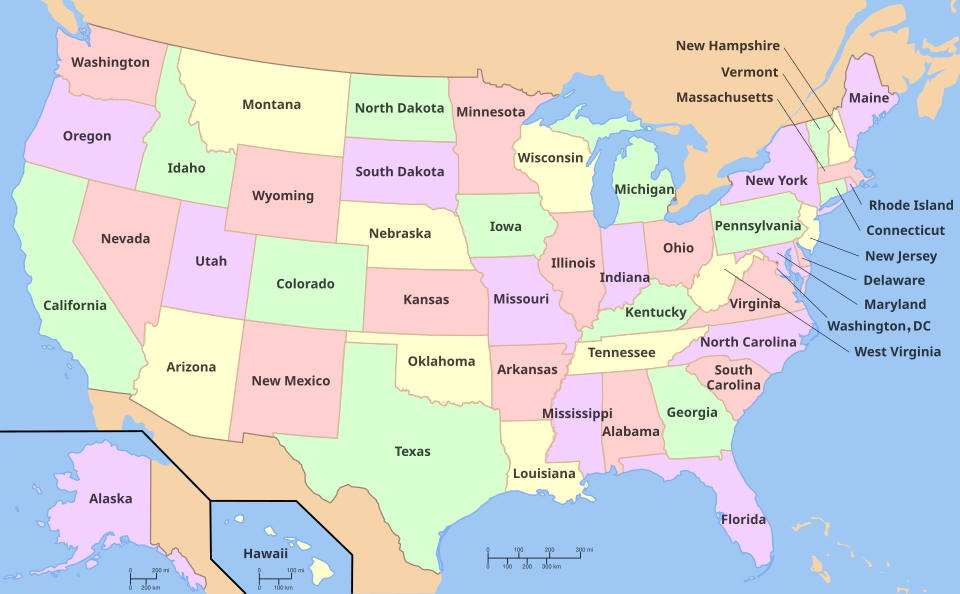
U.S. map (illustrative)
Image source: https://commons.wikimedia.org/wiki/File:Map_of_USA_with_state_names.svg. “Map of USA with state names” by Andrew c, via Wikimedia Commons, licensed under CC BY-SA 3.0.

Independent commissions do not eliminate:
- Partisan sorting
- Nationalized politics
- Media incentives
- Geographic concentration of voters
A fair map cannot make Los Angeles vote like rural California. The goal is not to erase differences. It is to stop politicians from choosing their voters.
A second hard truth. Even good commissions can be pulled into court. Litigation over district lines is now routine, and courts can end up ordering redraws on tight timelines.
Current example (New York, 2026)
Even with an independent redistricting commission, maps can be challenged and courts can order redraws on tight timelines.
- SCOTUSblog: https://www.scotusblog.com/2026/02/democrats-ask-supreme-court-not-to-disrupt-new-york-redistricting-dispute/
- Courthouse News Service (Feb 19, 2026), on the appellate ruling: https://www.courthousenews.com/new-york-court-greenlights-redistricting-of-gop-leaning-staten-island/
Update (September 25, 2026): On March 2, 2026, the U.S. Supreme Court stayed the trial court’s January 21, 2026 order requiring the redraw, pending the appeal in the New York courts and any petition to the Supreme Court.
- Supreme Court order, Malliotakis v. Williams (No. 25A914): https://www.supremecourt.gov/opinions/25pdf/25a914_1p24.pdf
A simple standard for fair enough
A perfect standard does not exist. But there is a common-sense benchmark.
In our view, if a party wins about 52% of the vote, it should win roughly 52% of the seats, within reason.
When outcomes consistently look like 52% of the vote producing 60% of the seats, we are not debating philosophy. We are looking at math.
That benchmark is our opinion, and the law does not require it: in Rucho, the Supreme Court quoted an earlier opinion saying its cases “clearly foreclose any claim that the Constitution requires proportional representation.”[4] The ALARM Project, which simulates maps drawn to each state's criteria, notes that “proportionality isn’t guaranteed, even in a fair redistricting process”: in its simulated Illinois maps, Democrats, who win about 60% of the vote in a typical statewide election, won 11.1 to 12.6 of 17 seats on average, where a proportional share would be 10.1.[35]
Additional reading
- Why ranked-choice voting reduces extremism
- The Difference Between Oversight and Gridlock
- Princeton Gerrymandering Project: Redistricting Report Card: https://princetongerrymander.netlify.app/redistricting-report-card/
- NCSL overview: Redistricting commissions: https://www.ncsl.org/redistricting-and-census/redistricting-commissions-state-legislative-plans
- Brennan Center: Redistricting and gerrymandering resources: https://www.brennancenter.org/issues/gerrymandering-fair-representation
- SCOTUSblog (Feb 2026): New York redistricting dispute: https://www.scotusblog.com/2026/02/democrats-ask-supreme-court-not-to-disrupt-new-york-redistricting-dispute/
Sources
- Public Policy Institute of California (PPIC): https://www.ppic.org/publication/assessing-californias-redistricting-commission-effects-on-partisan-fairness-and-competitiveness/
- Brennan Center: https://www.brennancenter.org/our-work/analysis-opinion/anatomy-north-carolina-gerrymander
- Princeton Gerrymandering Project (report card): https://princetongerrymander.netlify.app/redistricting-report-card/
- Supreme Court (Rucho v. Common Cause): https://www.supremecourt.gov/opinions/18pdf/18-422_9ol1.pdf
- SCOTUSblog (Feb 2026, New York): https://www.scotusblog.com/2026/02/democrats-ask-supreme-court-not-to-disrupt-new-york-redistricting-dispute/
- Democracy Docket (Feb 2026, New York): https://www.democracydocket.com/news-alerts/new-york-appellate-court-allows-redraw-of-congressional-map-to-move-forward/
- U.S. District Court, S.D. Ohio (Gonidakis v. LaRose order, May 27, 2022): https://redistricting.lls.edu/wp-content/uploads/OH-gonidakis-20220527-order.pdf
- Court News Ohio (Jul 19, 2022, Ohio congressional map): https://www.courtnewsohio.gov/cases/2022/SCO/0719/220298_220303.asp
- Courthouse News Service (Feb 19, 2026, New York): https://www.courthousenews.com/new-york-court-greenlights-redistricting-of-gop-leaning-staten-island/
- Supreme Court (Malliotakis v. Williams, order on application for stay, Mar 2, 2026): https://www.supremecourt.gov/opinions/25pdf/25a914_1p24.pdf